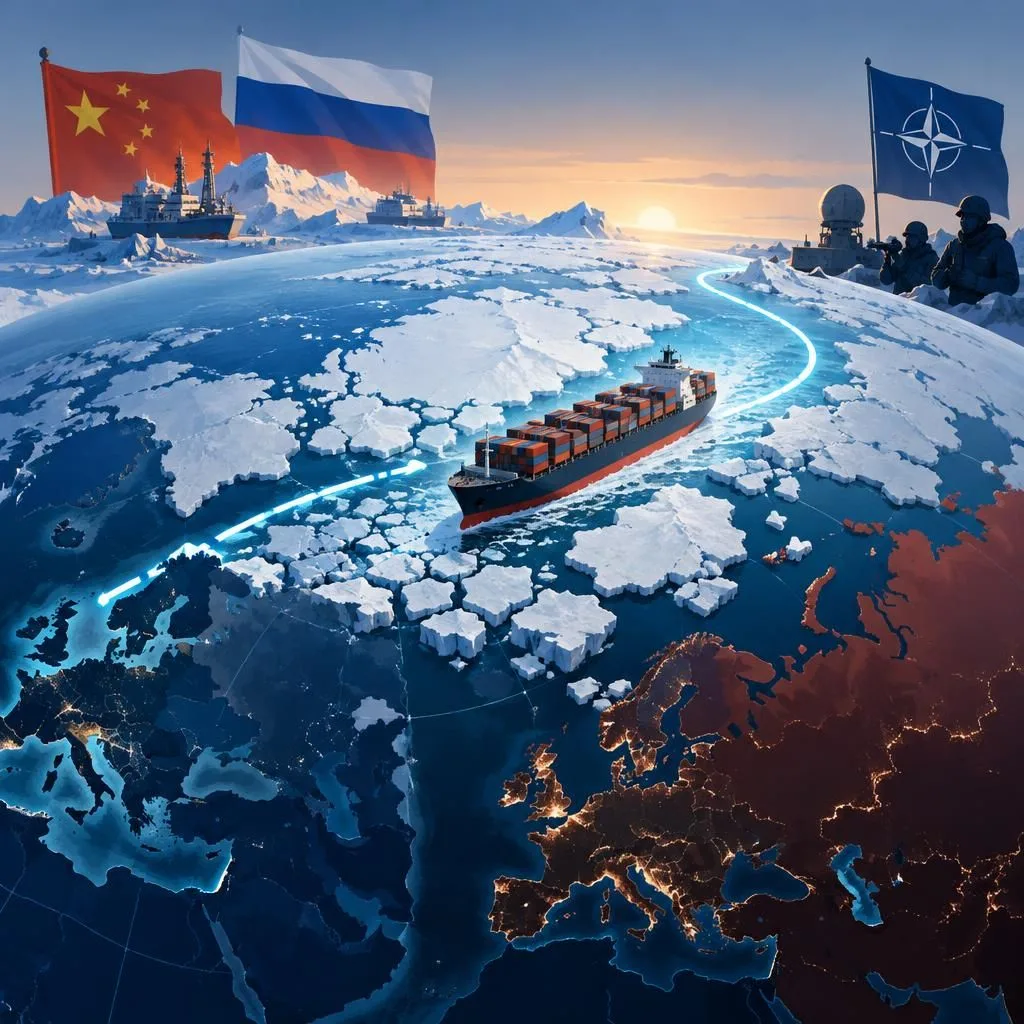
For centuries, the frozen waters of the Arctic Ocean stood as an impassable barrier to global commerce. Today, accelerating climate change and melting sea ice are turning theoretical shipping routes into practical conduits. Chief among these is the Northern Sea Route (NSR), a maritime corridor stretching along Russia’s northern coastline from the Kara Sea to the Bering Strait.
By shaving thousands of nautical miles and up to two weeks of transit time off conventional voyages through the Suez Canal or around the Cape of Good Hope, the NSR presents substantial commercial appeal. However, its emergence is not simply an economic milestone; it is fundamentally transforming maritime security, international law disputes, and military alignments across the globe.
Russia’s Strategic Bastion and Coastal Control
Russia controls the vast majority of the Arctic coastline adjacent to the route, viewing the NSR as both a vital national economic artery and a defensive shield. Moscow has poured extensive resources into building a formidable fleet of nuclear-powered icebreakers, modernizing coastal ports, and extracting massive hydrocarbon reserves in places like the Yamal Peninsula.
From a legal standpoint, Russia asserts broad jurisdictional control over the passage. Citing Article 234 of the United Nations Convention on the Law of the Sea (UNCLOS)—which grants coastal states special environmental regulatory rights in ice-covered areas—Moscow imposes strict navigation rules. Foreign vessels are required to request permission, submit to Russian inspections, and frequently hire Russian icebreaking escorts and maritime pilots.
Alongside commercial administration, Russia has steadily remilitarized its Arctic perimeter. Soviet-era radar installations and airfields have been refurbished, and modern anti-ship and air defense missile batteries have been deployed along the route. For Moscow, commercial logistics and naval defense are deeply intertwined; controlling the NSR protects Russia's northern flank and secures a toll-generating trade corridor insulated from Western chokepoints.
China and the 'Polar Silk Road'
Thousands of miles south of the Arctic Circle, Beijing has emerged as one of the most proactive players in the high north. In its 2018 Arctic Policy white paper, China declared itself a "near-Arctic state" and formally incorporated the Arctic into its Belt and Road Initiative under the moniker of the "Polar Silk Road."
China’s interest stems from both economic ambition and strategic anxiety. A significant share of Chinese energy imports and commercial exports currently travels through vulnerable maritime bottlenecks, most notably the Strait of Malacca. An accessible northern route offers a valuable hedge against maritime interdiction in the Indo-Pacific during potential geopolitical crises.
Following Western sanctions against Russia, Sino-Russian cooperation in the Arctic has deepened significantly. Chinese state-owned enterprises have provided critical financing and technical support for Russian liquefied natural gas (LNG) projects, while Chinese shipyards construct ice-class vessels capable of operating in polar waters. While both nations share an interest in counterbalancing Western naval dominance, subtle tensions remain: Moscow has historically been cautious about allowing foreign powers—including Beijing—excessive operational influence along its sovereign coastline.
Western Concerns and the Expanding NATO Flank
The United States and its NATO allies view the alignment between Russian territorial control and Chinese investment with mounting concern. Washington has long rejected Russia’s claim that key straits along the NSR constitute internal Russian waters, arguing instead that they represent international straits where foreign vessels enjoy the right of transit passage.
Beyond legal disagreements, the military balance in the region has shifted. The accessions of Finland and Sweden to NATO transformed seven of the eight Arctic Council members into treaty allies, leaving Russia diplomatically isolated in polar governance bodies. In response to heightened Russian military activity in the Barents Sea and the Kola Peninsula—home to Russia's sea-based nuclear deterrent—NATO has increased its joint cold-weather exercises and maritime surveillance patrols.
Western strategists also worry about the dual-use nature of Arctic infrastructure. Commercial deep-water ports, hydrographic survey operations, and satellite tracking stations built for cargo logistics can readily support naval intelligence gathering and submarine tracking in a conflict.
Commercial Realities vs. Geopolitical Friction
Despite the intense strategic focus, significant hurdles prevent the Northern Sea Route from replacing traditional southern sea lanes in the immediate future:
Navigational Hazards: Even with reduced summer ice, conditions remain erratic. Shifting multi-year sea ice, severe storms, and seasonal darkness require specialized ice-class vessels and experienced crews.
Infrastructure Shortfalls: Search-and-rescue capabilities, salvage infrastructure, and communication networks along the thousands of miles of Siberian coastline remain sparse, elevating insurance premiums.
Geopolitical Risk and Sanctions: Western sanctions following the full-scale invasion of Ukraine have led major international container lines to publicly avoid the route, largely leaving transit traffic to Russian, Chinese, and specialized bulk carriers.
A New Frontier of Global Politics
The opening of the Northern Sea Route demonstrates how environmental transformation directly reshapes international statecraft. Far from remaining an isolated expanse of wilderness, the Arctic is rapidly integrating into the broader architecture of global competition. As the ice continues to thin, the interplay between coastal sovereignty claims, alternative trade security, and allied naval posture ensures that the high north will remain a critical geopolitical flashpoint for decades to come.