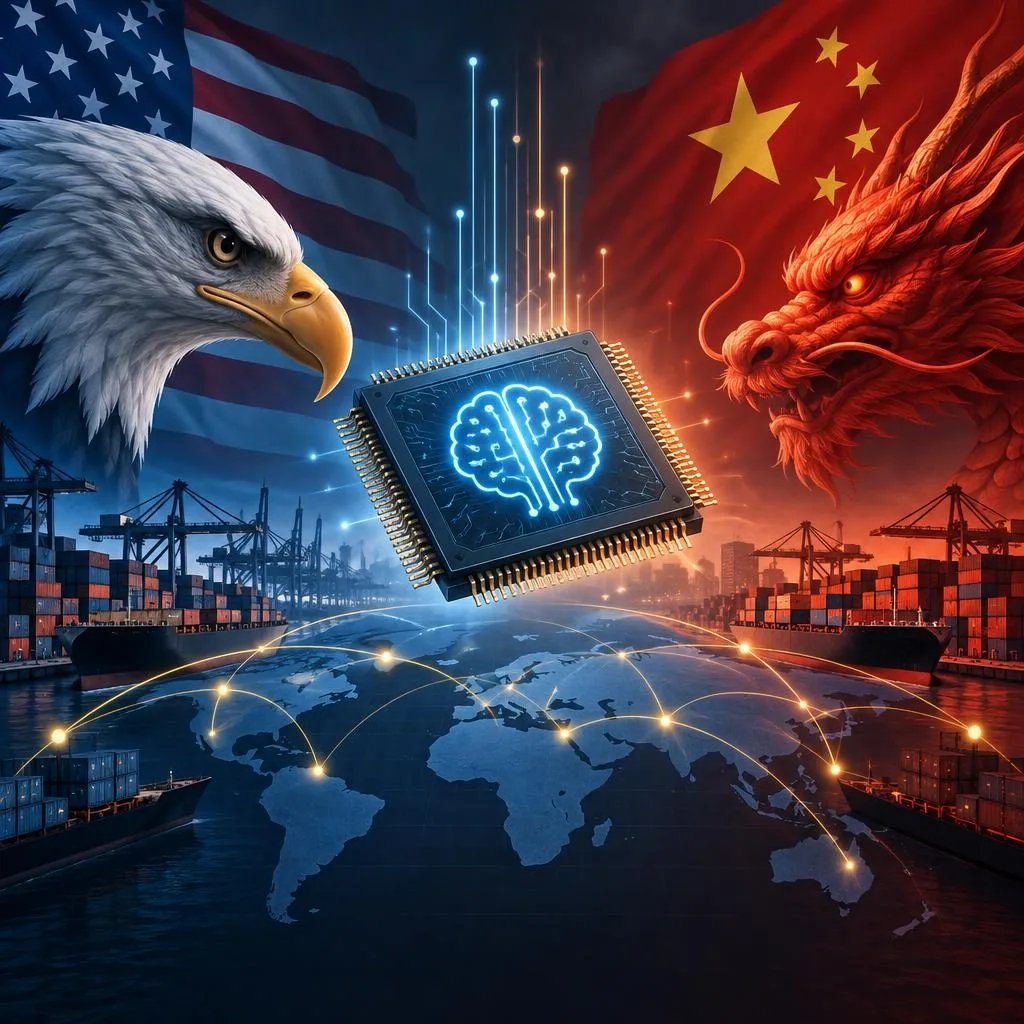
For decades, superpower rivalries were measured in nuclear warheads, naval tonnage, and territorial influence. In the twenty-first century, however, the balance of power between the United States and China is increasingly determined by nanometers and computing clusters. The strategic friction between Washington and Beijing has shifted from broad trade tariffs to a targeted, high-stakes contest for control over advanced semiconductors and artificial intelligence (AI).
At stake is not merely commercial profitability, but national security, economic sovereignty, and technological leadership. Both powers recognize that the nation leading in advanced computing will likely establish the technical standards, military advantages, and economic foundations for the decades ahead.
The Semiconductor Chokepoint: Why Silicon Matters
Modern artificial intelligence models, cloud computing infrastructure, and sophisticated defense systems depend entirely on advanced semiconductors—typically those manufactured at leading-edge nodes measured below seven nanometers. Yet the semiconductor supply chain is among the most concentrated and fragile global networks ever created.
Rather than being distributed evenly, critical stages of semiconductor manufacturing rely on narrow bottlenecks:
Extreme Ultraviolet (EUV) Lithography: The machinery required to print the most intricate circuitry onto silicon wafers is manufactured by a single Dutch company, ASML, relying on components sourced globally.
Contract Fabrication: A vast majority of the world's commercial leading-edge logic chips are manufactured in Taiwan, primarily by TSMC (Taiwan Semiconductor Manufacturing Company).
Chip Architecture and Design Software: Electronic Design Automation (EDA) tools and advanced processor architectures remain overwhelmingly dominated by American and allied firms.
Because no single country possesses an entirely domestic supply chain from raw silicon to packaged, cutting-edge chips, these chokepoints have become potent levers of geopolitical power.
The US Strategy: Containment and Reshoring
In recent years, the United States has moved from a philosophy of open global commerce to active protectionism and technological containment regarding national security technologies. This doctrine, often summarized as a "small yard and high fence" strategy, aims to protect foundational technologies without completely decoupling the broader consumer economies.
The strategy rests on three interconnected pillars:
Export Restrictions on Hardware: Sweeping rules enacted by the US Department of Commerce have restricted China's access to high-end graphics processing units (GPUs) tailored for AI workloads, as well as the advanced fabrication tools required to produce them domestically.
Allied Coordination: Recognizing that unilateral sanctions would simply redirect Chinese demand to competitors, Washington pressured key allies, including the Netherlands and Japan, to align their export control regimes on advanced lithography and etching equipment.
Domestic Industrial Subsidies: Through initiatives like the CHIPS and Science Act, the US government committed tens of billions of dollars to incentivize domestic chip fabrication, aiming to reduce dependence on East Asian supply chains in the event of regional conflict.
China's Playbook: Indigenization and Asymmetric Leverage
Beijing views Western restrictions not merely as commercial barriers, but as an explicit attempt to permanently suppress China's modernization. In response, the Chinese leadership has mobilized state resources at an unprecedented scale under the banner of "technological self-reliance."
China's approach focuses on both catching up at the frontier and dominating adjacent segments of the market:
State-Backed Investment: Through national investment vehicles such as the "Big Fund," alongside state subsidies and local government incentives, China has poured vast capital into domestic foundries, design houses, and equipment makers.
Legacy Node Dominance: While cut off from the most advanced nodes, Chinese manufacturers have expanded production of mature (or legacy) chips—the 28nm and larger components essential for automobiles, appliances, telecom base stations, and industrial machinery. This grants Beijing potential leverage over global consumer electronics and manufacturing supply chains.
Critical Mineral Controls: China has exercised export licensing and restrictions on critical raw materials where it holds dominant refining capacity, such as gallium, germanium, and graphite, signaling that supply chain disruptions cut both ways.
Artificial Intelligence as the Ultimate Arena
The struggle over silicon is fundamentally a battle for the engine of artificial intelligence. Advanced AI models require thousands of specialized accelerators clustered in massive data centers to train and deploy. By restricting access to these chips, the US seeks to slow China's progress in developing foundational frontier models.
The strategic utility of AI spans multiple dimensions:
Military Applications: From autonomous drones and electronic warfare to predictive maintenance and intelligence analysis, modern defense forces anticipate that AI integration will confer decisive battlefield advantages.
Economic Productivity: AI-driven automation, software synthesis, and biomedical discovery promise significant macroeconomic gains for the societies that deploy them effectively.
Norms and Governance: The developers of dominant global AI systems will heavily influence information ecosystems, digital censorship norms, and international data standards.
Despite hardware constraints, Chinese researchers have demonstrated significant resourcefulness, focusing on algorithmic efficiency, model optimization, and leveraging open-source research to maintain competitive software capabilities.
Global Ramifications and Lingering Uncertainties
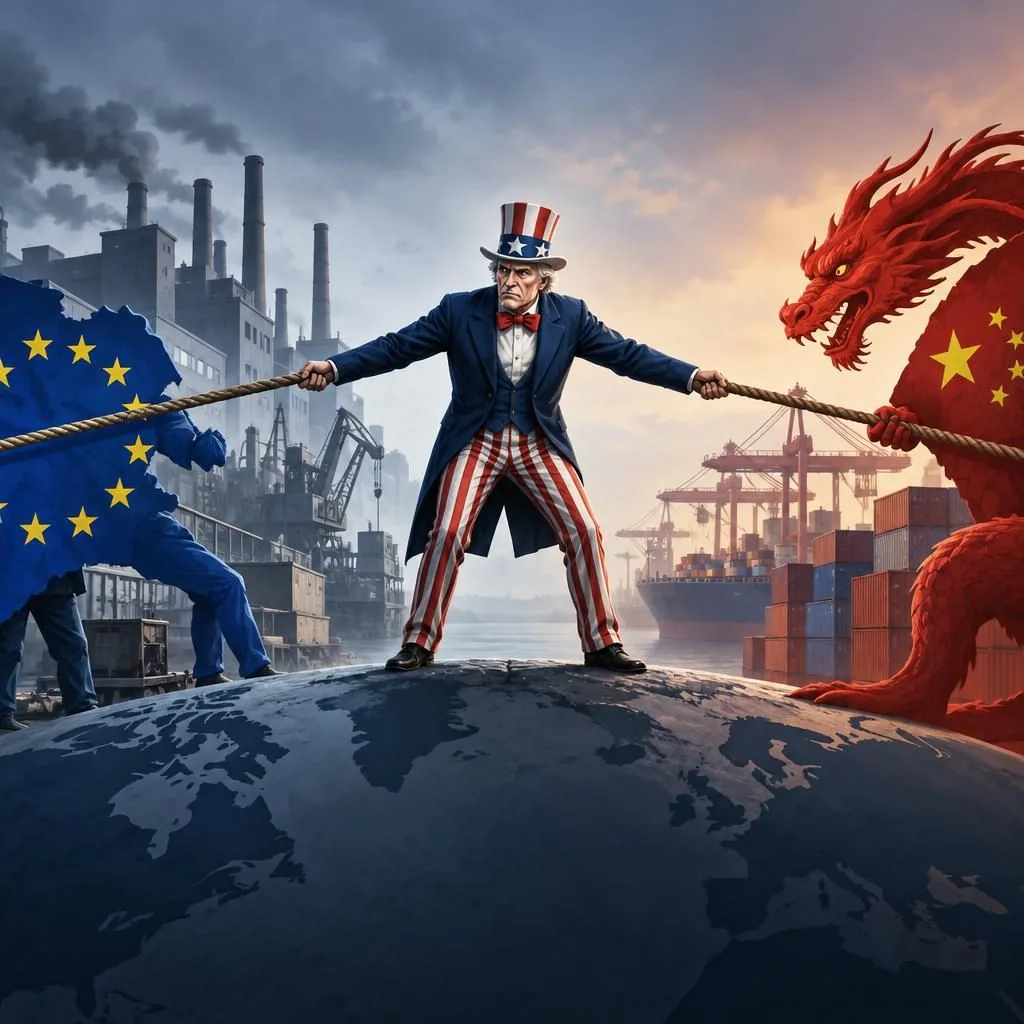
The bifurcation of the technological world carries substantial costs. For third-party countries and multinational corporations, navigating conflicting regulations and parallel technological ecosystems has become an operational necessity. European and Asian nations face pressure to pick sides, even as their commercial interests depend on maintaining open ties with both markets.
Crucial uncertainties remain as this rivalry evolves:
Will strict export controls permanently cripple China's frontier tech development, or will they merely serve as an accelerator for domestic innovation and indigenous workarounds?
Can Western nations realistically onshore capital-intensive, chemically complex manufacturing at commercial scale without driving up consumer costs and facing talent shortages?
How will the geopolitical risk surrounding Taiwan—the geographic center of advanced fabrication—impact international calculations as both powers attempt to diversify?
Conclusion: A Protracted War of Attrition
The US-China tech rivalry is not a temporary trade dispute that can be resolved with a single bilateral agreement. It represents a fundamental structural contest over the architectural backbone of the digital era. As the boundaries between commercial innovation and national defense continue to blur, computing power will remain the ultimate currency of twentieth-first-century geopolitics.