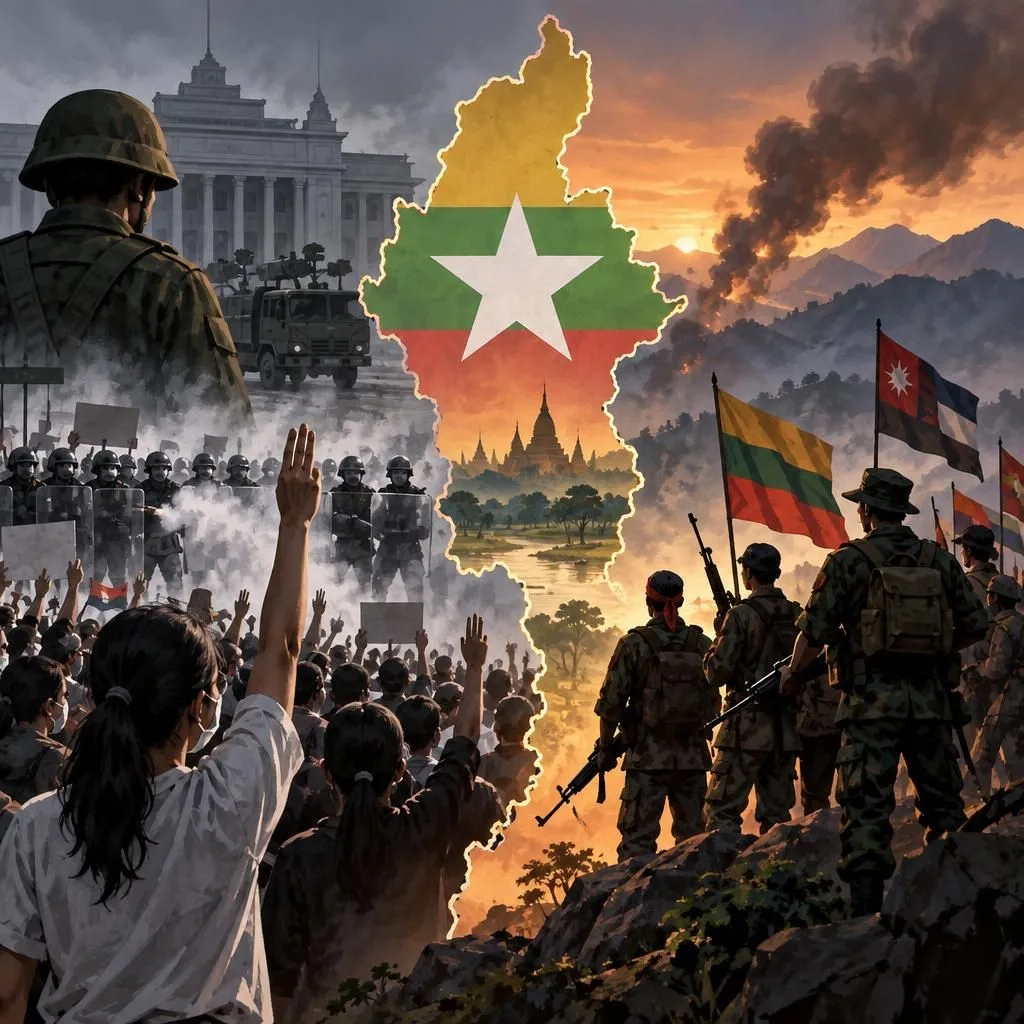
The civic resistance that erupted following the Myanmar military's coup in February 2021 has expanded beyond pro-democracy demonstrations into a nationwide civil war. As the democratic bloc's National Unity Government (NUG) and Ethnic Armed Organizations (EAOs) join forces against the military regime's State Administration Council (SAC), Myanmar's decades-long internal conflict has entered an unprecedented phase.
Key Opposing Factions and Power Structure
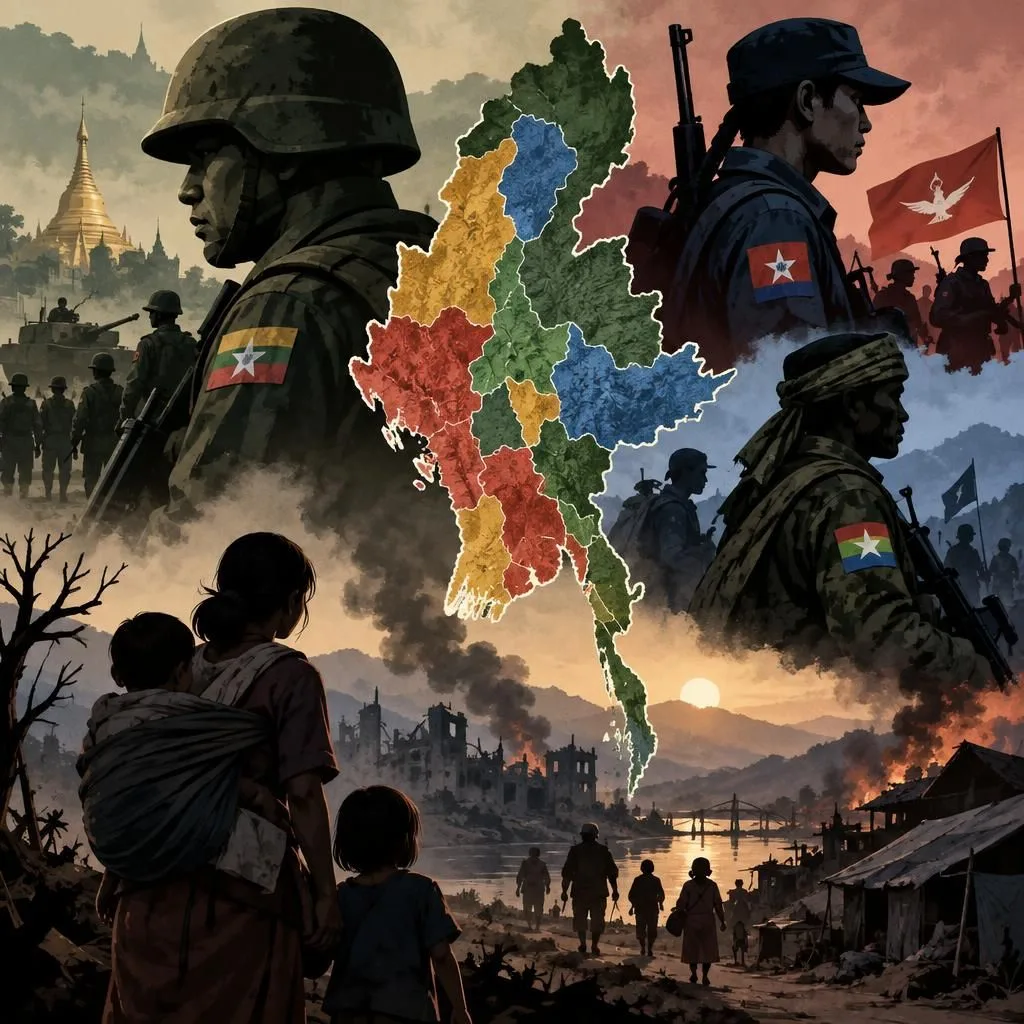
The Myanmar civil war currently unfolds around three primary axes. With battle lines extending beyond border regions into the central plains, power vacuums and territorial divisions have become deeply intertwined.
Military Junta (SAC): Maintains control over major metropolitan centers such as Naypyidaw, Yangon, and Mandalay, as well as the central administrative apparatus, holding clear superiority in air power and heavy artillery. However, due to troop casualties and recruitment shortages, its effective territorial control continues to shrink.
National Unity Government (NUG) and People's Defense Force (PDF): An interim government established by ousted lawmakers and civil society figures after the coup. Its armed wing, the People's Defense Force (PDF), conducts guerrilla warfare primarily across Bamar-majority central plains such as Sagaing and Magway.
Ethnic Armed Organizations (EAOs): Armed groups based in Karen, Kachin, Arakan, and Shan regions, among others, that have fought for self-determination for over half a century. While some cooperate militarily and politically with the NUG, others maintain diverse interests, focusing primarily on expanding their own autonomous territories.
Rapidly Shifting Battlegrounds and Border Clashes
Operation 1027, launched in late 2023 by an alliance of ethnic armed groups in northern Shan State, marked a decisive turning point in the war. The rebel coalition successively captured military strongholds and strategic cross-border trade hubs. Emboldened by this success, the Arakan Army (AA) in western Rakhine State and the Karen National Liberation Army (KNLA) in the east intensified their offensives.
Gradually losing control on the ground, the military junta has resorted to an attritional strategy heavily reliant on airstrikes and artillery shelling. This has resulted in widespread destruction of densely populated civilian areas and infrastructure, leaving front lines dispersed without fixed boundaries.
Deepening Humanitarian Crisis
The protracted armed conflict has produced an acute humanitarian catastrophe. Internally displaced persons (IDPs) have surged into the millions, while healthcare and education systems have broadly collapsed. Following the military's enforcement of a mandatory conscription law in early 2024, the exodus of youth abroad and their enlistment into rebel groups accelerated, dealing a severe blow to the country's economic production base.
Despite international sanctions and diplomatic mediation attempts, room for compromise between the military junta and resistance forces remains narrow. Continued military confrontation and an uncertain power-sharing framework stand as major obstacles to any long-term ceasefire negotiations.
Future Challenges and Uncertainties
Myanmar's future depends not only on the ouster of the military junta, but also on building a new federal democratic system as a multiethnic nation. Even within the anti-regime coalition, coordination between the Bamar-centric NUG and various ethnic minority groups regarding the distribution of political autonomy is essential. Furthermore, the strategic interests and border security concerns of neighboring powers remain complex variables in bringing an end to the civil war.