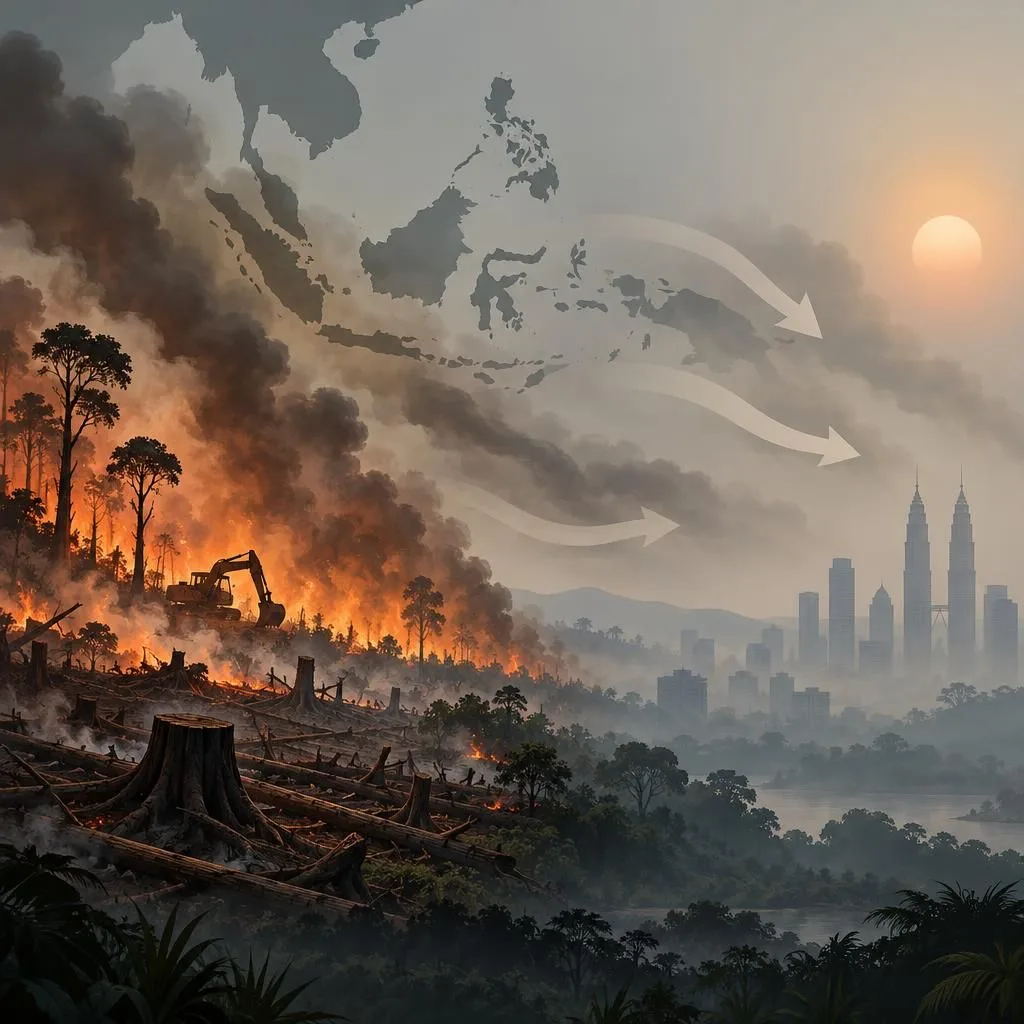
Every year when the dry season arrives, the skies across key Southeast Asian nations such as Indonesia, Malaysia, and Singapore become trapped in a thick, gray pall of smoke. Visibility drops to just a few hundred meters, and fine particulate matter (PM2.5) levels spike, triggering recurring school closures and flight cancellations. Known locally as the 'Haze,' this transboundary pollution phenomenon is not merely a seasonal weather shift, but a structural disaster resulting from the interplay between artificial land clearing and unique ecological conditions.
The Unquenchable Ground: The Secret of Peatlands
The primary epicenters of the haze are Sumatra and Kalimantan (Borneo) in Indonesia. Beneath the forests of these regions lies a thick layer of peat—partially decomposed plant matter accumulated over thousands of years instead of typical soil.
Naturally, peatlands are waterlogged giant wetlands that serve as one of Earth's most carbon-dense ecosystems. However, when drainage canals are dug to dry out the land for oil palm plantations or acacia pulp farms, the situation changes drastically. Once drained and dried out, peatlands turn into highly concentrated piles of natural charcoal primed to ignite at any moment.
Slash-and-Burn Agriculture for Cost Reduction and Incomplete Combustion
Clearing land with heavy machinery to remove trees and stumps requires immense time and financial resources. In contrast, 'slash-and-burn' agriculture—setting fires during the dry season—is viewed as a cheap and convenient alternative, traditionally practiced by smallholders and certain agribusinesses alike.
Persistence of subterranean combustion: Even after surface flames are extinguished, embers continue to smolder covertly meters deep within the peat layers, burning for weeks or even months.
Surge in toxic gases and particulate matter: Incomplete combustion occurring under oxygen-depleted underground conditions releases vast quantities of carbon monoxide, methane, hydrogen cyanide, and high concentrations of fine particulate matter.
Transboundary Spread Driven by Weather and Wind Patterns
Behind the cross-border spread of this fire smoke into neighboring countries such as Malaysia and Singapore lie monsoon winds and climate variability.
Typically between June and October, Southeast Asia is governed by the southwest monsoon, with winds blowing from the southwest to the northeast. This naturally creates an atmospheric pathway that carries smoke generated in Sumatra and Kalimantan across the Strait of Malacca straight into Peninsular Malaysia and northern Borneo.
During El Niño years in particular, severe droughts multiply wildfire risks severalfold and magnify the scale of haze devastation. When accompanied by atmospheric stagnation, the smoke becomes trapped over urban centers rather than dispersing, causing respiratory illnesses and paralyzing daily routines.
Challenges for a Structural Solution
The haze issue has long fueled diplomatic friction between affected countries and source nations. Although the ASEAN Agreement on Transboundary Haze Pollution was signed in 2002, the lack of binding enforcement mechanisms has limited its real-world efficacy.
A fundamental solution requires rewetting degraded peatlands and transitioning toward sustainable agricultural practices. Blocking drainage canals to raise water tables, coupled with satellite-based fire monitoring systems and rigorous law enforcement, will be essential to lifting the gray pall that blankets Southeast Asian skies every dry season.