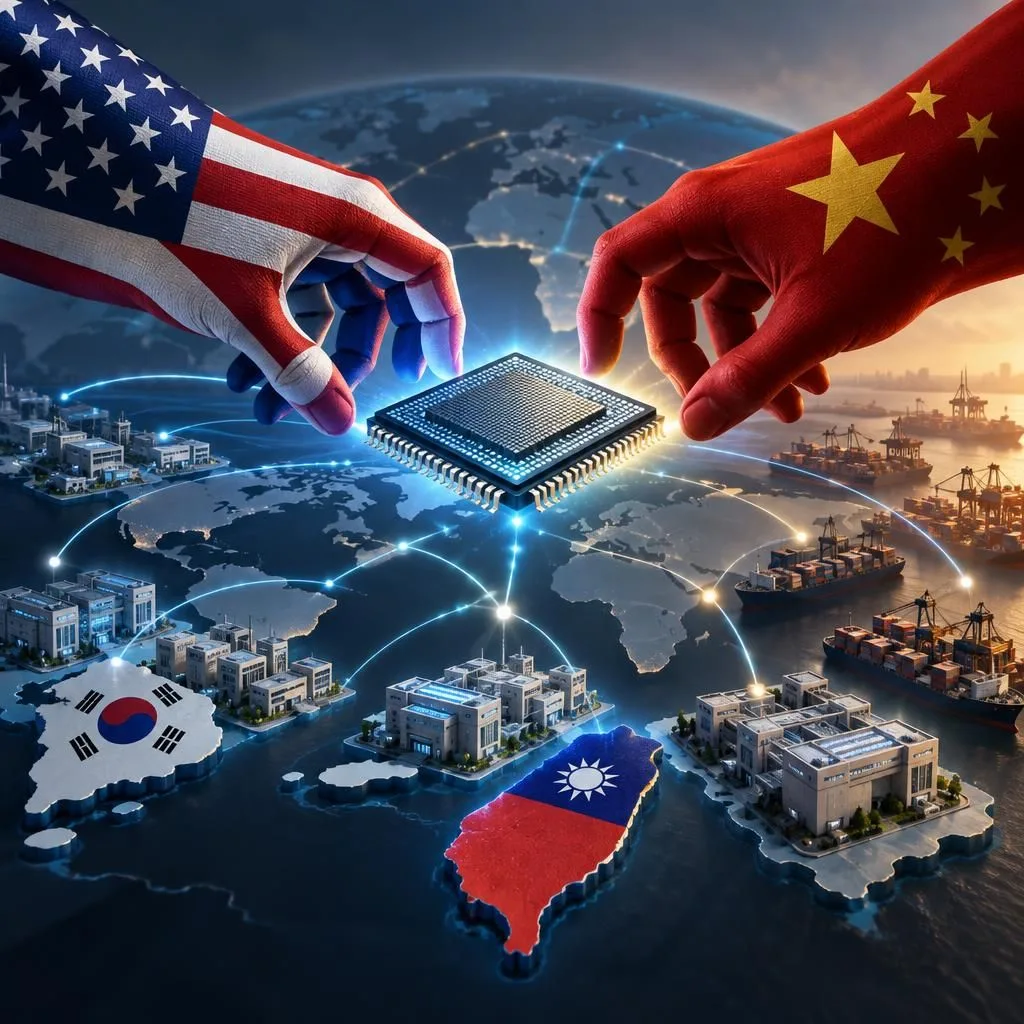
Often hailed as the "rice of modern industry," semiconductors have transcended mere electronic components to become core assets for national security and future hegemony. With advanced technologies spanning artificial intelligence (AI), quantum computing, autonomous driving, and defense heavily reliant on ultra-fine chips, the conflict between the United States and China is expanding across the entire semiconductor value chain.
US Strategy: Export Controls on Advanced Equipment and Supply Chain Realignment
Leveraging its foundational technologies and design capabilities, the United States is pursuing a containment strategy to block China's entry into advanced semiconductors. Key measures include restricting exports of advanced manufacturing equipment, such as extreme ultraviolet (EUV) lithography systems, to China, as well as controlling the supply of chips used for high-performance computing.
Concurrently, the US is implementing supportive policies to revive its domestic manufacturing ecosystem. While subsidizing global chipmakers building production hubs on American soil, it seeks to forge a resilient, trusted supply chain that excludes China through close coordination with allies.
China's Response: Localization Drive and Dominance in Mature Nodes
Confronted with US sanctions, China is deploying massive state-led capital to achieve semiconductor self-reliance. While exploring technical workarounds in response to restricted access to cutting-edge nodes, it is heavily investing in mature (legacy) nodes of 28 nanometers and above, which are widely used in home appliances and automobiles.
Fostering an autonomous ecosystem capable of absorbing external shocks by raising the localization rate of materials, parts, and equipment
Securing dominance over the global legacy chip supply chain by expanding its foundry market share in mature nodes
Intensively nurturing the power semiconductor sector in tandem with the electric vehicle and renewable energy industries
Geopolitical Dilemmas Facing South Korea and Taiwan
Taiwan, home to TSMC, the world's leading foundry, and South Korea (Samsung Electronics, SK Hynix), a powerhouse in memory chips, stand on the front lines of this semiconductor war. Companies in both nations face the intricate task of aligning with the US-led technological alliance while managing ties with China, which remains a massive consumer market and key production base.
As awareness spreads that concentrating advanced manufacturing capacity in specific regions poses severe geopolitical risks, pressure from global fabless companies to diversify supply chains is also mounting.
Taiwan, in particular, amid security tensions across the Taiwan Strait, is implementing a "China Plus One" strategy by dispersing production facilities across the US, Japan, and Europe. South Korean firms face a similar challenge: balancing major manufacturing investments in the US with restrictions on upgrading their existing fabrication facilities in China.
Future Outlook: Fragmented Value Chains and the Critical Need for a "Super-Gap" Advantage
Once built on efficiency and the global division of labor, the semiconductor supply chain is rapidly fragmenting into security-focused blocs. While this shift may yield inefficiencies, such as redundant capital expenditures and rising production costs, major economies appear willing to bear these burdens to safeguard technological sovereignty.
Ultimately, the future trajectory of semiconductor supremacy will hinge on maintaining an unrivaled "super-gap" technological edge. Only those nations and enterprises that secure irreplaceable capabilities—such as next-generation packaging technologies to overcome the limits of node miniaturization, AI-tailored High Bandwidth Memory (HBM), and neuromorphic chips—will maintain bargaining power amid the turbulent reorganization of the global supply chain.