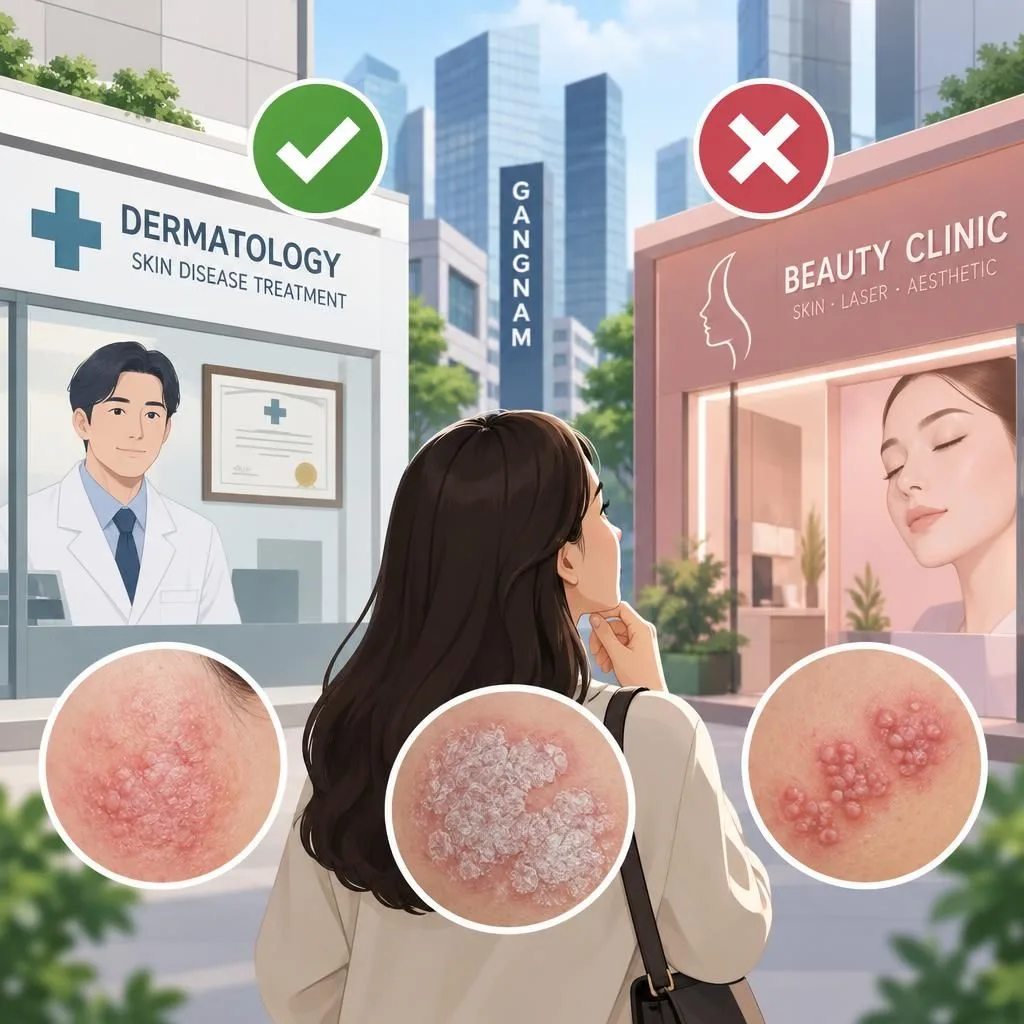
Gangnam is internationally renowned as a hub for cosmetic procedures, laser toning, and aesthetic skin care. However, if you are experiencing an acute or chronic skin condition—such as contact dermatitis, severe eczema, shingles, psoriasis, or an unexplained rash—locating a clinic that focuses on medical diagnosis rather than aesthetic enhancement can be challenging. Many clinics in the district prioritize private cosmetic packages and may offer limited evaluations for standard dermatological diseases.
Fortunately, South Korean medical regulations and professional associations provide clear indicators to help patients identify qualified medical dermatologists.
1. Decode the Clinic Signboard and Legal Name
Under the South Korean Medical Service Act, clinic names must follow strict formatting rules depending on whether the primary physician is a board-certified specialist (jeonmun-ui) in dermatology.
Board-Certified Dermatologist Clinic: The name will place the specialty directly before the word clinic. For example, OO Dermatology Clinic (OO 피부과의원). Only physicians who completed a four-year dermatology residency and passed the national specialty exam may register this exact format.
General Clinic Practicing Dermatology: If a general practitioner or a specialist from another field (such as family medicine or surgery) runs the clinic, the specialty must appear after the word clinic in smaller text. The standard legal format is OO Clinic, Department of Dermatology (OO 의원 진료과목 피부과).
Checking the exterior signboard, building directory, or official website header for the exact phrasing 피부과의원 is the fastest way to confirm board certification.
2. Look for the AKD Red Specialist Emblem
The Association of Korean Dermatologists (대한피부과의사회) issues an official emblem to verified board-certified practitioners. This emblem typically features a red square emblem containing the silhouette of a face and the Korean text for dermatologist specialist (피부과 전문의).
You can also search a practitioner's name or clinic location directly on the Association of Korean Dermatologists public directory (akd.or.kr) or through the Health Insurance Review and Assessment Service (HIRA) portal to confirm their credentials before visiting.
3. Review the Services and Equipment
While many certified dermatologists in Gangnam offer aesthetic laser treatments alongside medical care, their treatment menu reveals whether they actively manage disease. Indicators of a medical focus include:
National Health Insurance coverage: A willingness to provide standard insurance-reimbursed care (급여 진료) for viral warts, fungal infections (tinea), contact allergies, and atopic dermatitis.
Diagnostic tools: Availability of dermoscopy, potassium hydroxide (KOH) fungal preparations, allergy patch testing, or skin biopsy procedures.
Therapeutic equipment: Specialized phototherapy devices (narrowband UVB or excimer lasers) for vitiligo and psoriasis, or liquid nitrogen cryotherapy setups for viral warts and seborrheic keratoses.
4. How to Confirm Before Booking
Because phone receptionists at cosmetic-heavy practices may state that their clinic does not handle general disease consultations, it is advisable to call ahead with specific questions:
Ask directly if the doctor sees general medical skin conditions: "피부 질환 진료도 보시나요?" (Do you examine skin diseases?)
Specify your symptom (e.g., hives, wart removal, shingles, eczema) to confirm they stock the necessary topical or oral medications and cryo-supplies.
Inquire whether an advance appointment is mandatory. Many disease-oriented clinics accept walk-ins during morning hours, whereas cosmetic clinics operate strictly on scheduled appointment slots.
When to Consider a General or Tertiary Hospital
For severe or refractory disorders—such as extensive blistering diseases (pemphigus), advanced autoimmune conditions, or suspected cutaneous malignancies—primary neighborhood clinics may refer patients to higher-level facilities. Gangnam and its surrounding districts host major medical institutions, including Gangnam Severance Hospital and Samsung Medical Center, which feature specialized dermatology departments with extensive pathology and inpatient capabilities. For tertiary care, obtain a medical referral note (jinryo uiroeseo) from a local clinic first to ensure standard National Health Insurance coverage.